Monday, 22 August 2016

Sitting arrangement questions for competitive exams

Types of sitting arrangements

Usually three type of sitting arrangement questions are asked in competitive exams like SSC,UPSC,IBPS,SBI,CAT,MAT etc..
  1. Circular Arrangement
  2. Rectangular/square Arrangement
  3. Linear Arrangement
Here we are sharing simplest method to solve sitting arrangement questions in competitive exams.

Circular Sitting Arrangement

In this arrangement persons are seated around a circle ,either facing the centre or away from the the centre.When everyone facing the centre of circle then,the clockwise movement is the left direction and anticlockwise movement is the right direction.
When everyone facing away from centre then,the clockwise movement is right direction and anticlockwise movement is the left direction.


In some questions, some persons will be facing centre and others facing away from centre.In such cases, right and left of each person should be marked individually.


Rectangular/Square Sitting Arrangement

In this arrangement persons are seated around a rectangle or a square.Like in circular arrangement there can be three type of questions.All sitting inwards,all sitting outward and some are sitting inward&others are sitting outwards.Marking left and right is same as above.

Linear Sitting Arrangement

In linear sitting arrangement persons are seated in a single row or two rows.
In single raw arrangement,there are two type .
1.All are facing a single direction

2.Some facing a direction and others facing opposite direction.


If persons are sitting in two rows ,there are two possibilities.
1.Both row facing each other.


2.Both row facing away from other.


How to solve sitting arrangement questions?

Here is the step wise method to solve sitting arrangement questions in minimum time.

  1. Read all statements.
  2. Identify specific statements.(Specific statements are that statements which clearly defines the relative positions of one or more persons or specific statements are those statements which can be directly marked in a diagram)
  3. Convert the specific statements into a diagram.
  4. Incorporate other statement into the diagram.
  5. Check whether all statements are true in the diagram drawn.

Now lets practice some examples from each category.

Example1:A,B,C,D,E,F,G are H are sitting in a circle facing towards the centre.E is between H and D.H is third to the left of B and second to the right of A.C is between A and G.B and E are not facing each other.Based on the given condition ,answer the following questions

  1. Who is third to the left of G.
  2. Who is between D and B.
  3. Who is sitting second to the right c.

Solution:
Step1:Identify 'specific statement'."H is third to the left of B and second to the right of A"-this is the specific statement because from this statement you can clearly identify relative position of H,B and A

Step2:Convert the specific statement into a diagram.
Step3: Incorporate remaining statements into diagram.
"E is between H and D"
"C is between A and G"

Now only one seat vacant.So fill it with F.

Step4:Verify whether all statements are satisfied in the diagram drawn.
Answers:
1.E
2.There is no one.They are sitting next to each other.
3.F
Please note statement "B and E are not facing each other" is redundant.

Example2:In a meeting P,Q,R,S,T and U are sitting around a rectangular table.P is sitting on a side alone.Q,R are sitting on the same side.U is facing P.S is the immediate left of U.R is facing S.Then
1.Who is at immediate right of P?
2.Who is between Q and U?
Solution:Procedure is same as solving circular seating arrangement.
Step1: Identifying specific statement is bit different from circular arrangement.Here identification of specific statement has an additional condition.Besides relative position ,statement should also indicate at least one person's position on a side.So,here "P is sitting on a side alone" is the specific statement.
Step2:Convert the specific statement into a diagram.

Step3:Now incorporate other statements too.
Follow this order:"U is facing P"-"S is the immediate left of U"-"R is facing S"-"Q,R are sitting on the same side".
Step4:Verify whether all statements are satisfied in the diagram drawn.

Answer:
1.T
2.R

Example3:P, Q, R, S and T are sitting on a bench. P is sitting next to Q, R is sitting next to S, S is not sitting with T who is on the left end of the bench. R is on the second position from the right. P is to the right of Q and T. P and R are sitting together. In which position P is sitting ?

Solution:
Step1:Here in this question specific statements are-
1. "S is not sitting with T who is on the left end of the bench",because from this statement it is clear that T is sitting at left end.
2.And second specific statement "R is on the second position from the right"
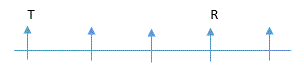
Step2:To proceed further combine statement "P is sitting next to Q" and "P and R are sitting together"
Step3:Now only one position is vacant.Place remaining person there.
Step4:Verify whether all statements are satisfied in the diagram drawn.
Answer:P is sitting in the middle

Sunday, 21 August 2016

Coding and Decoding questions for competitive exams

Coding and Decoding Questions with Answers


Coding and decoding is an important reasoning topic for most of the government competitive exams like IBPS,SSc CGL,SSC CHSL,RRB,RBI,SBI written examinations. In this page you can find Coding and Decoding important short cuts and tricks as well as coding and decoding practice questions with solution. We have tried to cover important coding and decoding test questions that are asked in SSC,UPSC,IBPS,RRB exams. We have used easiest shortcut methods and tricks for solving coding and decoding questions .

Definition of  Coding and Decoding

Coding:Coding is the process of converting a piece of information into another form of representation through symbols.
Decoding:It is the reverse process of coding by which coded data is converted back into original information.

Classification of Coding and Decoding

  1. Letter Coding
  2. Number Coding
  3. Substitution Coding
  4. Deciphering Coding
  5. Symbol Coding

Letter Coding and Decoding

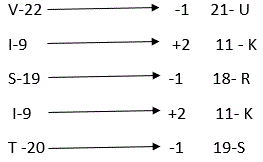
In this type of coding letters of a word are replaced by certain other letter according to a specific pattern/rule to form a code.To solve these kind of questions you must know position of alphabets from both ends.
Position of letters can also be remembered by the formula “EJOTY”.
E is 5th from left ,j is 10th from left and so on..
You can also use another formula “BGLQV” for getting position of letters in reverse order .
  
B is 25th from right ,G is 20th from right and so on..
Position of a letter from left=27- position of letter from right.

Example1:If in a code ‘MASTER’ is written as ‘SAMRET’, then how ‘PEOPLE’ be written in the same code?
  1.  1.PEOLEP
  2.  2.PLEOPE
  3.  3.EPPOEL 
  4.  4.OEPELP
Answer with explanation .( 4)In this position of letters are changed according to a specific pattern
coding and decoding  for bank exams
Example2:In a certain code ‘CANDLE’ is written as ‘FDQGOH’ then how will ‘MINUTE’ be written in the same code.
  1.  PLQXMH
  2.  PLQZNI
  3.  QMNYNJ
  4.  OLQXWG
Answer with explanation. (1)Here each letter is replaced by some other letter according to a specific pattern.Each letter is replaced by third letter right of that letter.
Similarly
Example3:In a code BOXER is written as AQWGQ  then VISIT is written as –
  1.  UKRKU 
  2.  UKRKS
  3.  WKRKU 
  4.  WKRKS
Answer with explanation:(2)
Similarly

Example4:If CEG is written as TSR and FHJ is written as QPO then IKM is written as-
  1. NOP 
  2. PON 
  3. MLK 
  4. NML
Answer With explanation:(4)


Example 5:In a certain code PLAN written as QBMS then RAIN is written as –
  1.  UBJQ 
  2.  UBJR 
  3.  QJBU
  4.  QBJU
Answer with explanation: (3)
coding and decoding
coding and decoding

Number Coding

In this type of coding numerical values are assigned to a word or alphabets according to predefined pattern.
Examle1: If ORAL is coded as 3196, then how can NUMBER be coded?
  1. 954253
  2. 592435
  3. 952435
  4. 235679
Answer with explanation:(3)

Substitution coding 

In this type of coding codes are assigned by the substitution method where in an artificial alternative is assigned to a given word and candidates are required to decipher the coding pattern to substitute the given word?
Example: If in a code language 'white' is called 'black', 'black' is called 'yellow', 'yellow' is called 'blue', 'blue' is called 'red' ,'red' is called 'green', then what is the color of human blood.
  1. yellow
  2. blue
  3. red
  4. green
Answer with explanation:(4) As, we know that colour of human blood is red ,here 'red' means 'green'.Hence, colour of human blood is 'green'.

Deciphering Coding

In these type of questions, a message bearing a common code for given word/numeral .Candidates are required to identify the code from the common property of word/numerals and decipher the given codes with best alternatives.
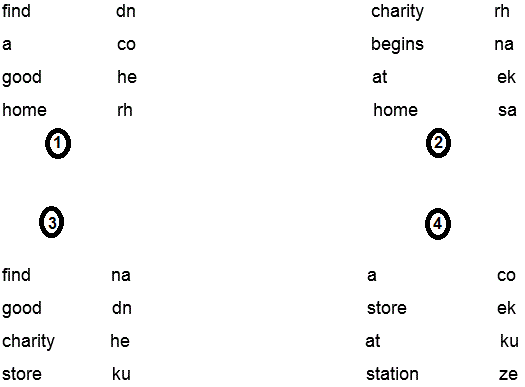
Example:In a certain code language “find a good home” is written as “dn co he rh”, “charity begins at home” is written as “rh na ek sa”, “find good charity store” is written as “na dn he ku” and “a store at station” is written as “co ek ku ze”. (All codes are two-letter codes only).
Solution:Arrange each sentence and their corresponding code as shown below.
Reasoning:coding and decoding
You will obtain four sets as above.Now consider the word 'find'. You can see the word 'find' in set 1 and set 3. You can also see the word 'good' is common to set 1 and set 3.If there are more than one common word in two set you cannot reach a conclusion.Now go for next word 'a'.The word 'a' is common to set 1 and set 4.There is only one common term between set 1 and set 4.Thus you can conclude that code of 'a' is 'co'. Draw a matching line connecting 'a' and 'co'. This will help you avoid confusion while making the right answer.From set 1 and set 2 you will get code of the word 'home' as 'rh'. Draw a matching line connecting the word and corresponding code.
Reasoning:coding and decoding


Continue above procedure for each word.Within 5-6 steps you can solve complete set of codes.You will get an arrangement like this.

Reasoning:coding and decoding
Note that code for the words 'find' and 'good' is either 'dn' or 'he'.

Symbol Coding

In this type of coding a set of symbol is assigned to a group of letters.Candidates are require to identify the relation between the symbol and decipher the pattern of coding and choose the best alternative.
Example: Ina certain code language ,'SAFER' is written as '5@3#2' and 'RIDE' is written as '2&%#',how would 'FEDS' be written in that code language?
  1. 3#&5
  2. 3@%5
  3. 3#%5
  4. 3#%2
Answer with explanation:(3)Here each letter is replaced by a symbol.Order of word and code is same.No shuffling or position pattern is applied.

For getting coding decoding questions with answers pdf ,kindly like and share this article and contact us through contact form given below.

Thursday, 18 August 2016

Problem based on ages for competitive exams

Age Related Problems-Important point

You can easily solve age related questions if you know how to solve linear equations.We are sharing some shortcut formulas for solving age related problems faster in competitive exams.
  • If present age of a person is x,then age of that person n years ago is x-y and age after n years will be x+n.
  • The present ages of A and B are x and y respectively.If A is n times older than B,then x=ny .If A is n years older than B,then x=y+n.
  • If the product of the present ages of A and B is x years and ratio of the present ages of A and B is a:b.Then, Age of A=a*sqrt(x/ab)                                                                                                                     Age of B=b*sqrt(x/ab)
  • If  a man's age is x% of what it was t1 years ago, but y% of what it will be after t2 years.Then his present age is (xt1+xt2)/(x-y) years.
  • In a group if one member is added then,Age of  new entrant =New average+ No of old members*change in average.
  • Age of new person =Age of the removed person+ No of members *change in average
  • If one person left then,Age of one who left=New average- No of old members*change in average.

Distance Time and Speed

Relation between time distance and speed 

Relation between time distance and speed  is given by the equationsSpeed=Distance/Time
          or
Distance=Speed*Time
          or
Time=Distance/Speed
Unit of speed is km/hr or m/s
If speed is given in km/hr,then inorder to convert it  in to m/s multiply by 5/18
1km/hr=5/18m/s
If speed is given in m/s,then inorder to convert it  in to km/hr multiply by 18/5

Ratio of speed

  • If ratio of speed of two moving object is a:b, then ratio between times taken for covering same distance is b:a. 
  • If two objects A and B moving in opposite direction from two different places reach at common point in t1 and t2 hrs respectively ,Then Speed of A:Speed of B=sqrt(t2/t1)

Average speed 

  • average speed=total distance/total time taken.
  • If a moving object covers a certain distance with a speed of x km/hr and again covers same distance with a speed of ykm/hr, then average speed is 2xy/(x+y).
  • If a moving object covers a certain distance with a speed of x km/hr and again covers same distance with a speed of ykm/hr and again with zkm/hr,then average speed is=3xyz/(xy+yz+xz)

Points to be noted while doing 'train and time' problems

  • If two trains are travelling in same direction ,then their relative speed is equal to difference of their speeds.Then Time taken by the fast train to cross the slower train is =Sum of lengths of both trains/difference of their speed 
  • If two trains are travelling in opposite direction ,then their relative speed is equal to sum of their speeds.Then time taken to pass one another is =Sum of lengths of both trains/sum of their speed. 
  • when a train is clearing a pole or a point, then distance covered by train is equal to its length 
  • When a train is covering a platform or bridge or tunnel ,then distance covered by train is equal to sum of the length of train and the length of platform/tunnel/bridge. 
  • When a moving train crosses another train, then distance covered is equal to sum of lengths of both trains. 

Boat and stream problems

  • If speed of stream=xkm/hr and speed of boat in still water is ykm/hrthen speed of boat in downstream=x+y km/hr ,speed of boat in upstream=y-x km/hr 
  • If speed of boat in upstream and speed of boat in down stream is given then, speed of boat in still water=1/2(speed in upstream+speed in downstream) , speed of stream=1/2(Speed in downstream - speed in upstream)

Pipe and cistern important shortcut formulas

Pipe and cistern important shortcut formulas

1.If two pipes A and B
A can fill a tank in x hrs and B can fill the same tank in y hrs
If both pipes are opened simultaneously ,then time taken to fill the tank is

Work done by both pipes together in 1hr=1/x +1/y

2.If two pipes A and B
A can fill a tank in x hrs and B can empty the same tank in y hrs
If both pipes are opened simultaneously ,then time taken to fill the tank is =

Work done by both pipes together in 1hr=1/x -1/y

3.If three pipes A ,B and C
A can fill a tank in x hrs,B can fill the same tank in y hr,and C takes z hrs for filling the same tank.
If three pipes are opened simultaneously ,then time taken to fill the tanks is

Work done by three pipes together in 1hr=1/x +1/y +1/z

4.If A can fill a tank in x hrs,B can fill the same tank in y hr and C takes z hrs for emptying the same tank.
If three pipes are opened simultaneously time taken to fill the tank is=


Work done by three pipes together in 1hr=1/x +1/y -1/z
hrs for filling.

Profit and loss formulas and shortcuts

Important points and formulas

  • Cost price(C.P)is the price at which a particular article is bought. 
  • Selling price(S.P) is that price at which a particular item is sold. 
  • Profit=S.P - C.P 
  • Loss =C.P- S.P 
  • Profit%=(profit*100)/C.P 
  • Loss%=(loss*100)/C.P 
  • the profit or loss percentage is always calculated based on C.P 
  • The overhead expenses are added to C.P. 
  • If A sold an article at a profit R1% to B.B sold it to C at a profit of R2% and C sold it to D at a profit of R3%.Then money spent by D for buying article C.P of D = C.P of A * (1+ R1/100)(1+ R2/100)(1+ R3/100). 
  • If there are two successive profits (R1% and R2%) obtained on an article then total profit%=(R1+R2+ R1R2/100). 
  • If a seller mark P% above cost price and gives a discount of Q%,the final Profit/loss %=P-Q-(PQ/100). 
  • Discount percentage is calculated on the marked price(M.P) 
  • Discount%= (Discount/M.P)*100 
  • Cost Price= [(100+Gain%)/(100-Discount%)]*100 
Download Percentage practice questions pdf for bank exams like ibps,rbi,sbi po and clerk

Work and Time problems shortcuts

Basic point to remember while solving work and time problems

First of all work done in 1 day is calculated.If a person completes a work in x days,then Work done by that person in one day is 1/x.

Solving work and time problems-some useful tips

  • If the number of persons doing a piece of work is increased(or decreased) in a certain ratio,the time needed to do the same work will be decreased(increased) in the same ratio.
  • If the number of men do a certain work be changed in the ratio m:n, then the ratio of time taken to finish the work changes i the ratio n:m.
  • If A is twice as good as B, then A will take half the time taken by B to complete a certain piece of work.
  • If M1 persons can W1 works in D1 days and M2 persons can do W2 works in D2 days, then we relation between M1,W1,D1,M2,W2 and D2 is M1D1W2=M2D2W1
  • If a A can do X/Y of work in 1 hr,then he will take Y/X hrs to finish the work.

Shortcut formula for solving work and time problems

1.If A can do a work in x days and B can do the same work in y days,then A and B together can finish the work in

This is the first and foremost shortcut formula for solving work and time problems.For understanding better, derivation of this formula is given below.
Derivation of above formula:
Work done by A in one day=1/x
Work done by B in one day=1/y
Work done by A and B together in 1 day=1/x+1/y
Then total days taken to complete the work by A and B together=1/ Work done by A and B together in 1 day
=1/(1/x+1/y)
=1/((x+y)/xy))
=xy/(x+y)

2.If A can finish the work in x days ,B can finish the same work in y days and C finishes it in z days, then number of days taken to complete the work if all three work together is
3.If A&B together can finish the work in x days,B&C together finishes in y days and C&A together finishes in z days,then work done by A,B and C together in 1 day is 

Monday, 15 August 2016

Mixture and alligation formulas and shortcuts

Mixture and alligation(If two commodities are mixed)

If two different commodities, one of which is cheaper than the other, are mixed to obtain a new mixture, Cost Price of unit value of this new mixture is called mean price.This is the the first and foremost formula you should remember to solve mixture and alligation questions.

Example:A merchant blends two types of rice costing Rs.15 per kg and Rs.20 per kg .In what ratio should these two rice to be mixed so that resulting mixture may cost Rs.16.50 per kg.


Note:

When water is mixed in milk or any liquid in such away that resulting mixture gives a profit of x% when sold at C.P of milk/liquid. Then ratio of Quantity water:Quantity of milk=x:100
Eg: In what ratio should water be mixed in milk so that seller makes a profit of 10% when mixture is sold at cost price of milk? Water : milk =10:100=1:10.

Solving mixture and alligation problems (If more than two different commodities are mixed)

Example:If A cost 95 per kg,B cost 60 per kg,C cost 90 per kg and D cost 50 per kg. They are blended in such a way that the cost price of resulting mixture is 80.In what ratio four commodities are mixed?
To solve these kind of problems follow the steps below
Step1: Arrange them in ascending order
50
60
90
95
Step2: Make couples ,one is above mean price and other is below mean price

Step3:Now find difference between price and mean price and write it opposite to the price linked to it.

Step3: Required ratio Qt of A: Qt of B: Qt of C: Qt of D=15:10:20:30=3:2:4:6

Mixture and alligation some important formulas to remember

In ‘n’ equal sized vessels two liquid P and Q are filled in the ratio p1:q1,p2:q2,p3:q3……….. pn:qn respectively
When they are mixed,

If vessels are of different quantities say x1,x2,x3….xn.

Removal and replacement problems

A vessel contains x litre of milk. y litre is drawn and replaced by water.Then again y litre of solution is replaced by water. If this process is repeated ‘n’ times,then

Example:9 litre are drawn from a cask full of milk and then filled with water.9 litre of mixture are drawn and cask is again filled with water.Quantity of milk now left in the cask is to that of water in at is as 16:9.What is the capacity of cask in litre?
Ans:let x be the capacity of cask which is=quantity of initial milk,


http://www.bankaspire.in/2017/07/mixture-and-alligation-practice-questions-pdf.htmlhttp://www.bankaspire.in/2017/07/mixture-and-alligation-practice-questions-pdf.html

IBPS Clerk Prelim model question paper pdf download

IBPS Clerk Preliminary model Paper pdf ebook   IBPS has already released Clerk Notification for CWE XIII 2023. The online examination (P...