Types of sitting arrangements
Usually three type of sitting arrangement questions are asked in competitive exams like SSC,UPSC,IBPS,SBI,CAT,MAT etc..
- Circular Arrangement
- Rectangular/square Arrangement
- Linear Arrangement
Circular Sitting Arrangement
In this arrangement persons are seated around a circle ,either facing the centre or away from the the centre.When everyone facing the centre of circle then,the clockwise movement is the left direction and anticlockwise movement is the right direction.
 When everyone facing away from centre then,the clockwise movement is right direction and anticlockwise movement is the left direction.

In some questions, some persons will be facing centre and others facing away from centre.In such cases, right and left of each person should be marked individually.

Example1:A,B,C,D,E,F,G are H are sitting in a circle facing towards the centre.E is between H and D.H is third to the left of B and second to the right of A.C is between A and G.B and E are not facing each other.Based on the given condition ,answer the following questions
Solution:
Step1:Identify 'specific statement'."H is third to the left of B and second to the right of A"-this is the specific statement because from this statement you can clearly identify relative position of H,B and A
Step2:Convert the specific statement into a diagram.
 Step3: Incorporate remaining statements into diagram.
"E is between H and D"
 "C is between A and G"
 Now only one seat vacant.So fill it with F.
 Step4:Verify whether all statements are satisfied in the diagram drawn.
Answers:
1.E
2.There is no one.They are sitting next to each other.
3.F
Please note statement "B and E are not facing each other" is redundant.
Example2:In a meeting P,Q,R,S,T and U are sitting around a rectangular table.P is sitting on a side alone.Q,R are sitting on the same side.U is facing P.S is the immediate left of U.R is facing S.Then
1.Who is at immediate right of P?
2.Who is between Q and U?
Solution:Procedure is same as solving circular seating arrangement.
Step1: Identifying specific statement is bit different from circular arrangement.Here identification of specific statement has an additional condition.Besides relative position ,statement should also indicate at least one person's position on a side.So,here "P is sitting on a side alone" is the specific statement.
Step2:Convert the specific statement into a diagram.
 Step3:Now incorporate other statements too.
Follow this order:"U is facing P"-"S is the immediate left of U"-"R is facing S"-"Q,R are sitting on the same side".
Step4:Verify whether all statements are satisfied in the diagram drawn.
 Answer:
1.T
2.R
Example3:P, Q, R, S and T are sitting on a bench. P is sitting next to Q, R is sitting next to S, S is not sitting with T who is on the left end of the bench. R is on the second position from the right. P is to the right of Q and T. P and R are sitting together. In which position P is sitting ?
Solution:
Step1:Here in this question specific statements are-
1. "S is not sitting with T who is on the left end of the bench",because from this statement it is clear that T is sitting at left end.
2.And second specific statement "R is on the second position from the right"
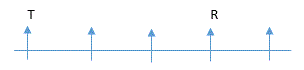
Step2:To proceed further combine statement "P is sitting next to Q" and "P and R are sitting together"
 Step3:Now only one position is vacant.Place remaining person there.
 Step4:Verify whether all statements are satisfied in the diagram drawn.
Answer:P is sitting in the middle
In some questions, some persons will be facing centre and others facing away from centre.In such cases, right and left of each person should be marked individually.
Rectangular/Square Sitting Arrangement
In this arrangement persons are seated around a rectangle or a square.Like in circular arrangement there can be three type of questions.All sitting inwards,all sitting outward and some are sitting inward&others are sitting outwards.Marking left and right is same as above.


Linear Sitting Arrangement
In linear sitting arrangement persons are seated in a single row or two rows.
In single raw arrangement,there are two type .
1.All are facing a single direction
 2.Some facing a direction and others facing opposite direction.

If persons are sitting in two rows ,there are two possibilities.
1.Both row facing each other.

2.Both row facing away from other.

In single raw arrangement,there are two type .
1.All are facing a single direction


If persons are sitting in two rows ,there are two possibilities.
1.Both row facing each other.
2.Both row facing away from other.
How to solve sitting arrangement questions?
Here is the step wise method to solve sitting arrangement questions in minimum time.
Now lets practice some examples from each category.- Read all statements.
- Identify specific statements.(Specific statements are that statements which clearly defines the relative positions of one or more persons or specific statements are those statements which can be directly marked in a diagram)
- Convert the specific statements into a diagram.
- Incorporate other statement into the diagram.
- Check whether all statements are true in the diagram drawn.
Example1:A,B,C,D,E,F,G are H are sitting in a circle facing towards the centre.E is between H and D.H is third to the left of B and second to the right of A.C is between A and G.B and E are not facing each other.Based on the given condition ,answer the following questions
- Who is third to the left of G.
- Who is between D and B.
- Who is sitting second to the right c.
Solution:
Step1:Identify 'specific statement'."H is third to the left of B and second to the right of A"-this is the specific statement because from this statement you can clearly identify relative position of H,B and A
Step2:Convert the specific statement into a diagram.
"E is between H and D"
Answers:
1.E
2.There is no one.They are sitting next to each other.
3.F
Please note statement "B and E are not facing each other" is redundant.
Example2:In a meeting P,Q,R,S,T and U are sitting around a rectangular table.P is sitting on a side alone.Q,R are sitting on the same side.U is facing P.S is the immediate left of U.R is facing S.Then
1.Who is at immediate right of P?
2.Who is between Q and U?
Solution:Procedure is same as solving circular seating arrangement.
Step1: Identifying specific statement is bit different from circular arrangement.Here identification of specific statement has an additional condition.Besides relative position ,statement should also indicate at least one person's position on a side.So,here "P is sitting on a side alone" is the specific statement.
Step2:Convert the specific statement into a diagram.

Follow this order:"U is facing P"-"S is the immediate left of U"-"R is facing S"-"Q,R are sitting on the same side".
Step4:Verify whether all statements are satisfied in the diagram drawn.

1.T
2.R
Example3:P, Q, R, S and T are sitting on a bench. P is sitting next to Q, R is sitting next to S, S is not sitting with T who is on the left end of the bench. R is on the second position from the right. P is to the right of Q and T. P and R are sitting together. In which position P is sitting ?
Solution:
Step1:Here in this question specific statements are-
1. "S is not sitting with T who is on the left end of the bench",because from this statement it is clear that T is sitting at left end.
2.And second specific statement "R is on the second position from the right"
Step2:To proceed further combine statement "P is sitting next to Q" and "P and R are sitting together"

Answer:P is sitting in the middle