Sunday, 21 October 2018

Average

What is Average?

The result obtained by adding several quantities together and then dividing this total by the number of quantities is called Average.

Formula
Average: = (Sum of observations / Number of observations)

Average speed

  • Average speed=total distance/total time taken.
  • If a moving object covers a certain distance with a speed of x km/hr and again covers same distance with a speed of ykm/hr, then average speed is
  • If a moving object covers a certain distance with a speed of x km/hr and again covers same distance with a speed of ykm/hr and again with zkm/hr,then average speed is
  • If a person covers A km at x km/hr and B km at y km/hr and C km at z km/hr, then the average speed in covering the whole distance is-

Average:Removal and Insertions of new term

  • When a person leaves the group and another person joins the group in place of that person then-If the average age is increased
    Age of new person = Age of separated person + (Increase in average × total number of persons)
    If the average age is decreased,
    Age of new person = Age of separated person - (Decrease in average × total number of persons)
  • When a person joins the group. In case of increase in average
    Age of new member = Previous average + (Increase in average × Number of members including new member)
  • In case of decrease in average
    Age of new member = Previous average - (Decrease in average × Number of members including new member)
Average of first n natural numbers
  • Sum of first n natural numbers,
  • Average = Sum of first n natural numbers/n,
 

Average of an arithmetic progression

An arithmetic progression (AP) or arithmetic sequence is a sequence of numbers such that the difference between the consecutive terms is constant.
For example 3,7,11,15……is an arithmetic progression with common difference of 4
Generally we can write an AP as a, a+d,a+2d,a+3d………,a+nd
‘a’ is the first term and ‘d’ is the common difference, ’n’ is the total no of terms.
nth  term of A.P is given by
 
This sum can be found quickly by taking the number n of terms being added ,multiplying by the sum of the first and last number in the progression, and dividing by 2:
 
Therefore Average of an A.P is


ie half of sum of first and last term.


Friday, 19 October 2018

Percentage

Percentage-Important Concepts and Formulas

The word ‘percent’ can be divided into two words, ‘per-cent’, mean per hundred or out of hundred.


Example1. Out of 250 students in a class ,150 are boys and remaining are girls. Find the percentage of girl students in the class.
Ans:No of girls=250-150=100
Percentage of girls

Example2: 10 % of x is 250.Find x?
Ans:10%x=250

Percentage important results and shortcut formulas

If x is increased by y%, then, new number 

If x is decreased by y%, then new number =

If X is m% more than Y, then Y is less than X by ?


Let If X is m% more than Y, then Y is less than X by-
If X is m% less than Y, then Y is greater than X by ?

If X is m% less than Y, then Y is greater than X by

If the price of a commodity increases by r%, then the reduction in consumption so as not to increase the expenditure is:

Derivation
Let P be the price of commodity, and consumption be 100 units.
Then total expenditure = P*100=100P……..(1)
Let n be the reduction in consumption
Then expenditure =
………….(2)
Equating (1) and (2)


If the price of a commodity decreases by R%, then the increase in consumption so as not to decrease the expenditure is:

Derivation
Let P be the price of commodity, and consumption be 100 units.
Then total expenditure = P*100=100P……..(1)
Let n be the reduction in consumption
Then expenditure=
.......(2)
Equating (1) and (2)

(Since the total consumption is 100)
If the value of a certain thing(P) increases R% every year,
Then value after n years

(note:formula is similar to that of compound interest)
Value before n years


-If the value of a certain thing(P) decreases R% every year Then value after n year

-If the value of a certain thing(P) decreases R% every year
Then value before n years

-If rate of increase is R1 for first year, R2 for second year,R3 for third year and so on. Then Value after n years is

Number Series questions

Number Series questions for competitive exams
Number series questions can be of two types. Picking the odd one out and find the missing number in the sequence.

Number series Type1: Spot the odd one 
In this type of questions, you will be given a number series in which one term doesn't follow the common relation that connects other terms. You have to spot that odd one.
Number series Type2: Find the missing one
In this type of questions, you will be given  a  number series in  which one term is missing. You have to find out that missing term.

Number series can also be classified based on the relation between successive terms. In other words 'how succeeding term is obtained from previous term'.
1.Addition/subtraction number series
In this type of series, succeeding term is obtained by adding/subtracting a particular number to the previous term. To solve this type of question, find the difference between successive terms. These 'differences' will form another series. Solve this 'differences' series first, then you can easily solve the original series.

Example1: Find the next term in the series 6   7    9   13    21    37     ?
Take the difference between successive terms.
· 7-6=1
· 9-7=2
· 13-9=4
· 21-13=8
· 37-21=16
· ?-37
Series formed by 'difference' terms is as follows.
1  2  4   8   16   ?
What comes in place of "?" ?.....Yes it is 32.
By adding 32 to 37 ,you get final answer. Thus answer is 69.

Example2: Spot the odd one in the series 5     6     10    18      35     60
· 6-5=1=12
· 10-6=4=22
· 18-10=8
· 35-18=17
·  60-35=25=52
Here you can see, no specific relation exist between 10&18 and 18&35.
So 18 is the odd one
Correct series is as follows

 5     6     10    19      35     60
· 6-5=1=12
· 10-6=4=22
· 19-10=9=33
· 35-19=16=42
· 60-35=25=52
2.Multiplication /Division number series
In this  type of series succeeding term is obtained by multiplying/dividing previous term by a particular number. To solve this type of question ,find the multiplication factor between terms and write it as a series. Solve these 'multiplication factors' series first. Then you can you can easily solve the original series.
Example1:Find the next term in the series. 3 6 15 45 157. 5 ?
· 6=3*2
· 15=6*2.5
· 45=15*3
· 157.5=45*3.5
Series formed by multiplication factors is 2  2.5   3   3.5   ?
What comes in place of "?" ? It is 4.
So ?=157.5*4=630.
Thus answer is 630.

Example2:Find the odd term in the series.1   2   8    72     1250
· 2=1*1^2
· 8=2*2^2
· 72=8*3^2
Here you can see  multiplication terms form a series 12    22   32   ?.
What comes in place of "?" ?.It is 42. So, 72*42=1152 comes in place of 1250.Thus odd one is 1250.

3.Combination of Addition/Subtraction and Multiplication /division series
In this type of series succeeding term is obtained by multiplying previous term by a number and adding/subtracting some other number. Like in above cases this multiplying/adding/subtracting number will form a series or a particular pattern. Try to identify the patterns that multiplying/adding/subtracting numbers are following. Then you can easily figure out pattern behind 
original series.

Example: 4     3     4     9    32
At first, by looking at the series you may not be able to figure out relation between successive terms. As already said, actually there exist  no 'specific logic ' to solve number series questions. You need to practice more and more questions, so that your brain will get adapted to these kind of problems. Now lets look into the pattern that above series is following.
· 3=4*1-1
· 4=3*2-2
· 9=4*3-3
· 32=9*4-4
You can see that multiplying terms and subtracting terms follows a certain pattern.

4:Apart from above categories ,series can be formed by adding/subtracting multiple numbers with previous term to get succeeding term.
Example:1   2     7     50     2507
· 2=12 +1
· 7=22 + 3
· 50=72 +5
· 2507=50+7

Partnership

Questions based on partnership

Partnership questions are regular in competitive exams like IBPS,UPSC,SSC,CAT,MAT and other eligibility tests. Usually this section is simple and you can score easily by understanding basic partnership concepts and formulas.

Partnership Important formulas and points to remember

When two or more than two persons jointly run a business , it is called partnership and persons involved are partners
1.Division of profit/loss is always proportional to investment.
2. When all the partners invest for the same time, the profit or loss is distributed among the partners in the ratio of their investments.
Suppose A and B invest Rs. x and Rs. y respectively for a year in a business, then at the end of the year:
(A's share of profit) / (B's share of profit) = x / y.
3. When investments are for different time periods, then equivalent capitals are calculate.Suppose A invests Rs. x for a period m and B invests Rs. y for a period n then,
(A's profit) /(B's profit)= mx/ny

Question1.A, B and C together invested Rs. 1,00,000 for a business. A sinvested Rs. 8000 more than B and B Rs. 10000 more than C. Out of a total profit of Rs. 70,000, A receives:
  • A.32000
  • B.42000
  • C.25800
  • D.24000
  • E.29400
Let x be the investment of C.
Then, B's investment = x + 10000
A's investment = x + 10000 + 8000 = x + 18000.
( x + x + 10000 + x + 18000) = 100000
3x = (100000-28000)=72000
x = 24000
A : B : C = 42000 : 34000 : 24000 = 42 : 34 : 24=21:17:12
A's share = Rs.[70000*(21/(21+17+12))]=70000*(21/50)=Rs. 29,400

Question2.A and B enter into a business in which A invest money four times than that of B. After a year A withdraws Rs.2000 while B doubles his money .They earn profits at 5% per annum of their capitals. At the end of the second year B gets Rs.600 as profit. Find the profit obtained by A. 
  • A. Rs.1200 
  • B. Rs.5000 
  • C.Rs.7000
  • D.Rs.5500 
  • E.None of these 
Ans.E.
Profit of Rs.600 at 5% per annum will be on investment= 600*(100/5)= 12000.
Therefore total investment of B for both years= Rs.12000.
Let investment of B in first year is x ,then x + 2x =12000 => x=4000
Investment of B for first year = 4000 and that of second year=8000.
Investment of A for first year= 4 * investment of b for first year= 4*4000=16000.
Investment of B for second year= 16000-2000=14000.
Total investment of A for two years= 16000+14000=30000.
So, profit of A= 30000*(5/100)=1500.

Question3.Three partners shared the profit in a business in the ratio 5 : 7 : 8. They had partnered for 14 months, 8 months and 7 months respectively. What was the ratio of their investments?
  • A. 5 : 7 : 8
  • B. 20 : 49 : 64
  • C. 38 : 28 : 21
  • D . 98:40:35
  • E. None of these
Answer:Option B
Explanation:
Let their investments be Rs. x for 14 months, Rs. y for 8 months and Rs. z for 7 months respectively.
Then, 14x : 8y : 7z = 5 : 7 : 8.
14x/8y=5/7
=>y=(14x/8)(7/5)=98x/40
14x/7z=5/8
=>z=(14x/7)(8/5)=112x/35
Therefore,  x : y : z=x: 98x/40: 112x/35
=1:98/40:112/35=20:49:64

Thursday, 18 October 2018

Solving Syllogism questions Faster for Bank,PSC,IBPS,RRB,RBI,SSC,CGL exams

Definition of  Syllogism

What is the meaning of syllogism ?The word syllogism is derived from a Greek word ‘syllogismos’ means "conclusion, inference" .Syllogism is a kind of logical argument that applies deductive reasoning to arrive at a conclusion based on two or more propositions that are assumed to be true.

How to solve Syllogism for competitive exams?

Almost every competitive exams or aptitude test included syllogism questions. Syllogism reasoning questions are asked all banking,SSC,RRB,UPSC exams. Most of the candidates find "syllogism " bit confusing. But this is one of the section from which you can easily score without much effort. Once you understand the concept of syllogism thoroughly there will be no place for confusion. Here we are discussing syllogism tricks & syllogism rules for solving questions faster.  Three ways you can solve syllogism questions depending on the type and complexity of questions asked.
  1. Cross cancellation and vertical cancellation.
  2. Immediate inference(Deduction of conclusion from a single statement).
  3. Venn diagram method.

Cross cancellation and vertical cancellation

These two methods are extremely simple, but not effective in complex questions. You can use this method for solving "direct and simple syllogism questions".
Following are the main rules for solving Syllogism Problems :
1. All + All=All
2. All + No=No
3. All + Some=No Conclusion
4. Some + No= Some Not
5. Some + All=Some
6. Some + Some= No Conclusion
7. No + Some=Some Not (Reversed)
8. No + All = Some Not(Reversed)
9. No + No=No Conclusion
10. Some Not /Some Not Reversed + Anything = No Conclusion

Solving two statement syllogism using Cross cancellation method

Example1:Statements:All maps are roads, Some roads are cities.
To deduce relation between maps and cities you can use cross cancellation.
 
Strike out common term “roads”. What is left? “All maps are” and “Some are cities”. From above table All + Some=No conclusion.So , no specific relation between roads and cities can be drawn from above statements.

Example2:No pencil is  a chair,All pens are pencils
Reverse the order of statement for simplicity,
All pens are pencils
No pencil is a chair
 
Strike out common term pencil. All+No=NO.So, relation between pen and chair is “No pen is a chair”

Example3: No bag is a computer,Some computers are ice-cream
 
Strike out common term computer.
NO+Some=Some not(reversed)
So, relation between bag and ice-cream is “Some ice-cream are not bags”.

Cross cancellation method for three statement syllogism
Example.Some mangoes are apples,All apples are oranges,All oranges are pineapple.
 
Strike out common term from first and second statements.
Strike out common term from second and third statements also.
From first and second statements Some + All = Some
Add this result to next, ie Some+All=Some
So, relation between mangoes and pineapples is “Some mangoes are pineapples”

Vertical cancellation method to solve syllogism

Example.No car is a bike,Some buses are bike.
Here in this set of statements , there is no scope for cross cancellation. When you find questions like this, go for vertical cancellation method.
 
Strike out common term “bike”.
No + Some=Some Not (Reversed)
Thus , relation between car and buses is “Some buses are not car”.
Immediate inference(Deduction of conclusion from a single statement)
In some cases you can deduce conclusion from a single statement. Such cases are tabulated below.


Statement
Conclusion (Immediate inference)
All A are B
Some A are B, Some B are A
Some A are B
Some B are A
No A is B
No B is A


Two statements Syllogism Practice questions with answers.

In each of the following questions below are given two statements followed by two conclusions .You have to take given statement to be true even if they seem to be at variance with commonly known facts. Read all the conclusions and then decide which of the given conclusions logically follows from the given statements disregarding commonly known facts.
Give answer
a)If only conclusion I is true
b) If only conclusion II is true
c) If either I or II is true
d) If neither I nor II is true
e) If both are true

Questions
1.Statements:All nails are ears, Some ears are eyes
Conclusions:I.All ears are nails , II.Some eyes are nails

2.Statements:All books are shrubs, All trees are shrubs
Conclusions:I.Some shrubs are books, II.Some shrubs are trees

3.Statements:Some books are birds, Some bird are fingers
Conclusions:I.Some fingers are books, II.Some finger are birds

4.Statements:All dogs are monkeys, No monkey is cat
Conclusions:I.No dog is a cat, II.No cat is a dog

5.Statements:Some phones are watches, All watches are guns
Conclusions: I.All guns are watches, II.Some guns are phones
Answers:1.d, 2.e, 3.b, 4.e, 5.b

Solving Syllogism possibility questions using Venn diagram 

This method is suitable for solving 3,4 or 5 statement syllogism .
Before solving questions ,let us understand Venn diagram for possible statements.
1.Statement:”All A are B”
Possible Venn diagrams.
fig1

fig2
Let us see whether following conclusions follows ‘ the above statement  or not. A Conclusion follows if and only if conclusion is satisfied in all possible conditions of the statement. That means conclusion must be possible in all Venn  diagrams we have drawn .

 
You can see only conclusions 2 and 3  clearly  follows .But look at the conclusions 1 and 7,there is a possibility for these  conclusions to be true. If the conclusions 1 and 7 are modified as below
1=> All A being   B is a possibility(see fig.2). and
7=> Some B  not being  A is a possibility (see fig.1).
Then the answer will be’ YES’ and ‘YES’. Hope it is clear….Now let us go to next statement
2.Statement:”some A are B”
Possible Venn diagrams.
fig3

fig4

fig5

fig6
 Let us see whether following conclusions follows the above statement or not.


You can see only conclusion 3 clearly follows. But in some cases there is possibility for conclusions 1,2,6 and 7 to be true. If we  modify 1,2,6 and 7 as follows.
1=> All A being B is a possibility.(see fig.4 and fig.6)
2=>All B being A is a possibility.(see fig.5 and fig.6)
6=>Some A not being B is a possibility(see fig.3 and fig.5)
7=>Some B not being A is a possibility(see fig.3 and fig.4)
Then these conclusions follows the statement.

3.Statement:"Some A are not B"
 Possible Venn diagrams.
fig7
fig8
fig9

 
None of the conclusion follows directly. But there exist possibility for conclusion 2 to 7.If we modify them
2=>All B being A is a possibility? YES (fig.8)
3=>Some B  being A is a possibility? YES(fig.7 and fig.8)
4=>No A being B is a possibility ?YES(fig.9).
5=> No B being  A is a possibility ?YES (fig.9).
6=> Some A being  B is possibility?YES(fig.7 and fig.8).
7=> Some B  not being  A is a possibility.?YES(fig.7 and fig.9).
Hope you understood ….

4.Statement:"No A is B"
Possible Venn diagram
fig10

  
Conclusions 4,5 and 7 follows. In this case there is only one Venn diagram possible ,therefore there is no possibility cases.
Now let us do some simple problems.
Q1)Statement :Some Pens are Pencils.
                        All Pencils are Books.
Conclusions:1.All the Books are Pencil
                     2. Some Pens are Book.
                     3. All Pen being Book is a possibility.

or
 
 Ans:1-NO,2-YES,3-YES.

Q2)Statement:Some Dogs are Cat.
                       Some Cats are Cows.
 Conclusions:1.Some Dogs are Cows.
                     2. Some Cats are Dogs.
 
or
 
 ANS:1-NO,2-YES

Q3):Statements:All cars are Chair.
                          No Chair is Mug.
Conclusions:1.No car is mug.
                     2.All Chair are cars.
 
ANS:1-YES,2-NO

3,4 statement Syllogism practice questions
Q1.Statements
1.All Watches are Keys
2.All Keys are Cats
3.Some Bats are Cats
Conclusions:
1.Some Cats are watches
2.All Keys are Watches
3.Some Bats are watches
4.Some Bats being Key is a possibility.
Options :
1.All 4 conclusions  are true
2.Only 1 and 4 follows
3.only 2 and 3 follows
4.none of the conclusions follows

 
ANS:2
Explanation:
Look at conclusions 1,2 and 3 .From fig.1 itself, you can conclude whether these conclusions are valid or not. But conclusion 4 is a possibility case. In such cases ,we have to find out whether ‘any such diagram exist where this conclusion is valid’. We know that number of diagrams are possible for a statement. So, many diagrams can be drawn for a set of statements. Modify Fig.1, incorporating possibility case(Some Bats being Key is a possibility) to get fig.2 .You can see none of the statement is violated in fig.2. So conclusion 4 holds true.

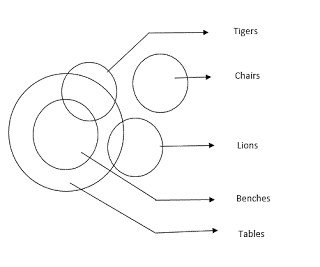
Q2.Statements
1.Some Lions are Tables
2.All Benches are tables.
3.Some Tigers are Benches
4.Some Chairs  are not Tigers
Conclusions:
1.Some Benches are Tigers
2.Some Lions are Tigers
3.Some Chairs are not Benches
4.Some Tigers are tables
5.All Chair being Table is a Possibility.
Options:
1.only 1,2,4 and 5 are true .
2.only 1,4and 5 are  true.
3.Only 1,2,3 and 4 are true.
4.none of the above.
 
Modified diagram (incorporating possibility conclusion in above diagram).
 
ANS:2

Q3.Statement:
1.All Trees are Fruits
2.All Fruits are vegetables
3.No Vegetable is Sweet.
Conclusion
1.No Fruit is Sweet
2.All Vegetables are Fruits
3.Some Sweets are Fruits
4.No Vegetable is Tree.
Options :
1.only 1 is true
2.All are true
3.Only 1 and 4 are true
4.Only 2 and 3 are true
 
ANS:1

Those who want Syllogism sample questions with answer pdf may contact us through contact form given below. If you find this Syllogism questions and answers shortcuts tricks and methods useful don't hesitate to like and share. 

IBPS Clerk Prelim model question paper pdf download

IBPS Clerk Preliminary model Paper pdf ebook   IBPS has already released Clerk Notification for CWE XIII 2023. The online examination (P...